Batsuit
Batman the Dark Knight Returns 10th Anniversary Edition HardcoverThe Batsuit is the central wearable emblem of Batman's identity in The Dark Knight Returns. More than protective equipment, it makes Bruce Wayne's suppressed vocation visible again, turns memory into action, and gives Gotham City a figure around which fear, resistance, and collective purpose can gather. Its changing condition—from an old symbol recovered after retirement to an instrument of renewed combat and finally a sign that survives Bruce Wayne's apparent death—tracks the entire movement of Batman's return.
Definition and Return
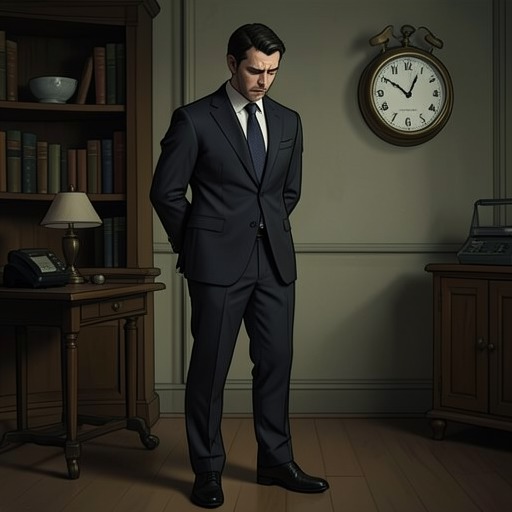
The Batsuit first matters as a sign of interruption. Bruce Wayne has withdrawn from Batman's life, and the abandoned costume belongs to the period in which Gotham City has learned to live without the vigilant figure it once feared. When Bruce Wayne resumes the identity, putting on the Batsuit is therefore not a simple change of clothing. It is the decisive act by which a retired public legend becomes an active presence again, converting private recollection into a new intervention in the city's social decay.
The suit also preserves continuity across a changed body. Bruce Wayne returns as an older man rather than as the physically unburdened hero of his earlier career. The familiar shape of the Batsuit carries the identity forward even when age, injury, and exhaustion make that continuity difficult. Its symbolic force depends on recognition: enemies understand what has returned, while citizens and institutions must respond to the fact that the old image has acquired a new, more dangerous historical meaning.
Instrument of Action
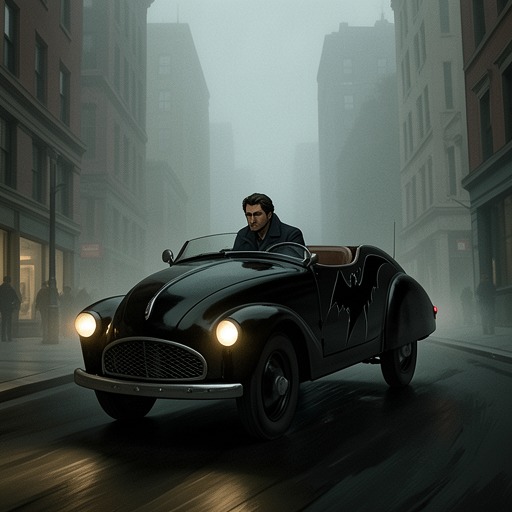
Once Bruce Wayne has returned, the Batsuit functions as part of a larger tactical system that includes the Batcomputer, the Batmobile, the Batarang, and the Bat-Signal. It enables Batman to move through situations in which ordinary law enforcement has lost control, while its visual design makes each intervention legible as the work of one continuing figure rather than as an isolated act of violence. The costume joins bodily presence to equipment, intelligence, transport, and communication, allowing Batman's authority to operate through both personal confrontation and organized response.
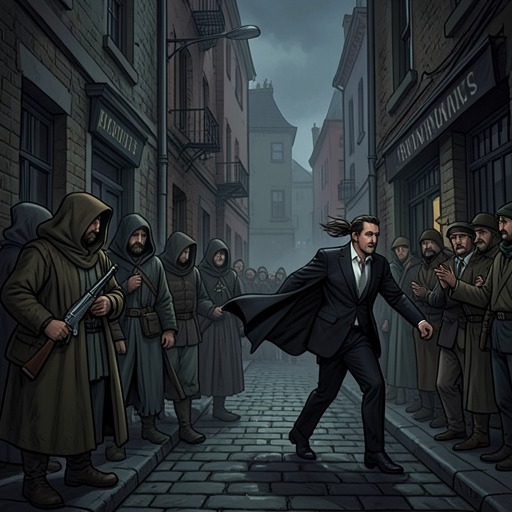
The Batsuit becomes especially significant during Batman's conflict with the Mutant Leader and the Mutant gang. The encounter tests not only Bruce Wayne's strength but also the relation between an aging human body and the myth attached to the costume. The suit cannot erase physical limitation; instead, it concentrates the remaining force of the wearer into preparation, intimidation, and close combat. Batman's victory over the Mutant Leader consequently restores the suit's credibility in the eyes of Gotham City, transforming a supposedly obsolete costume into proof that the old symbol can still alter political reality.
The costume's meaning expands when Batman's actions move from individual pursuit to civic mobilization. During Gotham City's blackout and the breakdown of public order, the Batsuit helps turn Bruce Wayne into a coordinating presence for people who must reclaim their streets. It is no longer merely camouflage for a solitary crime-fighter. Its recognizability supplies a frame for collective action: citizens can interpret Batman's appearance as an instruction to resist panic and restore order, while the later rise of the Sons of Batman shows how the symbol can be taken up by others and converted into an organized social force.
Conflict, Damage, and Public Meaning
The Batsuit repeatedly stands at the junction between legitimate protection and extralegal power. Gotham City Police Department treats Batman as a dangerous outlaw, while frightened or desperate citizens may see him as the only remaining source of security. The costume intensifies this conflict because it makes the disputed authority visible. A uniform normally represents an institution; the Batsuit represents a person whose methods bypass official procedures, yet whose presence can produce effects that the institutions have failed to achieve.
Its symbolic authority is also vulnerable to physical damage and political reinterpretation. The suit belongs to a world of bodily risk, and every confrontation places the idealized image of Batman against the material limits of Bruce Wayne. That tension becomes most consequential in the confrontation with Clark Kent / Superman. Against an opponent whose power is fundamentally different, the Batsuit does not make Bruce Wayne invulnerable; it becomes the visible shell of a strategy based on planning, technology, concealment, and the refusal to surrender the field of human agency. The resulting battle turns the costume into a statement about what Batman believes a human being can still do in an age dominated by superhuman force and state power.
Apparent Death and Continuation
After Batman's staged death, the Batsuit's meaning changes again. The public believes that Batman has been removed from history, and the visible identity appears to have ended with Bruce Wayne. Yet the disappearance is part of a deliberate design. By separating the public image of Batman from the continued life of Bruce Wayne, the staged death allows the costume's authority to become less dependent on a single public appearance and more adaptable to a hidden network of action.
In the aftermath, Bruce Wayne uses the legacy of the Batsuit while working with the Sons of Batman and preparing a new order outside the old structures of Gotham City. The suit thus becomes a bridge between generations. It recalls the figure who fought the Mutant gang, confronted the Joker, and opposed Superman, but it also points toward a collective future in which Batman's methods and symbols can be taught, repeated, and redirected. The object's final power lies in this transfer: it is not simply preserved as a relic of Bruce Wayne's past, but made into the visible memory of a continuing mission.
Narrative and Thematic Significance
The Batsuit gives the story a material language for identity continuity. Bruce Wayne's return is narrated through the recovery of a recognizable object, so the question of whether an aging man can still be Batman is answered partly through the suit's ability to make the past present. It operates as personal memory, public icon, tactical equipment, and political insignia at once. Those functions overlap without becoming identical, which is why the same costume can inspire terror in criminals, alarm in officials, loyalty among followers, and renewed hope among citizens.
The suit also reveals the cost of turning a human life into a symbol. It protects and conceals Bruce Wayne, but it cannot remove age or consequence; it strengthens the legend while exposing the body that sustains it to repeated danger. Its trajectory therefore refuses a simple fantasy of restoration. Batman does not return to an unchanged Gotham City or an unchanged self. The Batsuit returns with him, carrying the weight of retirement, renewed violence, public controversy, and eventual succession. By the end, its most important function is no longer to prove that Bruce Wayne can remain forever unchanged, but to show how an identity can outlive the individual form that first gave it force.